

 Scuba
Replacement Cards!
Scuba
Replacement Cards!
 Online Scuba Lessons |
 Online Nitrox Lessons |
The Stage Dependent
Learning Theory
with Scuba Diver
Certification.

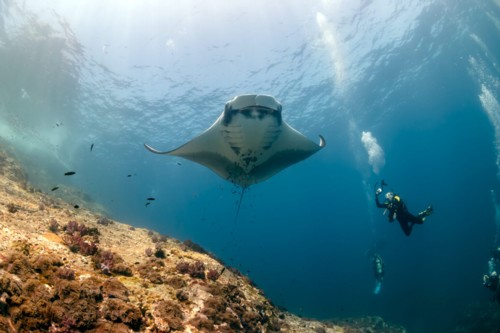
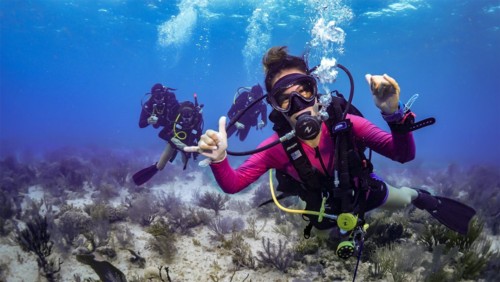
From the perspective of a scuba diving instructor, teaching diving is more closely related to education than to recreation. Information exists that is transferred to others - the knower and the known. As such, there seems to be a progression that all divers follow as they strive to master the knowledge and skills of scuba diving. This progression, which I refer to as "The stage dependent learning theory", can be applied to most learning situations, not just diving. It becomes, however, a useful gauge to assess a scuba diver's progress and comfort level and provides the diver with a reassuring means for self-assessment.
There are four stages involved as one moves from novice to master: Unconscious Incompetence, Conscious Incompetence, Conscious Competence, and Unconscious Competence.
Unconscious Incompetence
In this phase, one simply doesn't know what one doesn't
know. It may also be called the "Ignorance is Bliss" stage
if, and it's a big if, nothing goes wrong. The skills
aren't mastered (incompetence) yet there is a lack of awareness
that anything needs to be mastered (unconscious). A good
example of this would be the uneducated snorkeler who attempts
to surface dive to a depth of 20 feet without understanding the
need to equalize air spaces or the skills on how to do so. Similarly, the
well intentioned certified diver who lets the same snorkeler
breathe from a regulator at 20 feet (assuming that equalization
occurred by divine intervention) would serve as another example
of "Unconscious Incompetence". Sometimes what you don't
know you don't know can create frustration; at other times,
tragedy.
Most scuba diving students enter training at this level. Furthermore, even students who have completed the Basic Scuba Diver course may be left with a false sense of mastery and venture into situations beyond the scope of their training and knowledge. A little information combined with over-confidence can be very dangerous.
Conscious Incompetence
At this point, students are becoming aware, sometimes painfully,
of their lack of skill and knowledge. This is directly
facilitated when a student enters into a new learning
relationship with the instructor and is exposed to new
information or skills.
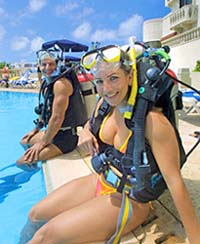
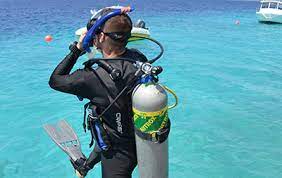
The skill of mask clearing represents a prime example. A bit of water in the mask of a snorkeler would be "no big deal" as it could easily be dealt with at the surface. Yet the same student experiencing a leaking mask on scuba without having mastered the skill of clearing, faces a different and unsettling situation.
During the stage of Conscious Incompetence, the student becomes aware of their limitations. It is by far the most frustrating phase for the student. It is at this point that I find myself playing the role of psycho-coach to assure the student that it can be done and "You can do it". As an instructor, this stage is where I encounter fear of the unknown. It is also difficult for some instructors to realize that this Conscious Incompetence unfolds naturally, it need not be pushed or forced. The instructor is there to help the student get through their fears, not to help them "get over them".
Conscious Competence
Let's return to the student learning how to clear that
ever-leaking mask. OK, lem-me see, press the finger tips
on the top of the mask, then ah, tip my head back - no
wait! Exhale, then tip my head back - right-on! It
worked! I did it!
Conscious Competence is a stage demanding extreme concentration. The diver thinks through every step, hoping and praying not to miss anything. Diving at this point is very mechanical and does not exactly fit those pre-course visions of gliding effortlessly and weightlessly with the spotted Eagle Rays. Students may come out of the water feeling very tired, due in part to the extended period of intense concentration (or apprehension) they have just experienced. Nevertheless, the sense of accomplishment and accompanying emotions are dramatic and very gratifying for both the student and the instructor.
Unconscious Competence
Unconscious Competence is the level at which students perceive
their instructor's abilities. At this stage, an observer
would consider someone to be a "natural." Everything is
effortless. Mastery of skills is at the point where
flawless execution is second nature and not consciously analyzed
or synthesized. Reactions become virtually
instinctive. Seldom do students realize, however, that
even instructors experience situations of water up the nose or
bouncing up and down in search of neutral buoyancy. This
level is sometimes difficult to attain and even more difficult
to maintain. It is the result of moving through the three
previous phases and "over-learning skills" (attainment) as well
as the continual execution of those skills through practice
(maintenance). Without maintenance, it would not be
difficult to go full circle and return to the level of
Unconscious Incompetence.
To summarize, it was mentioned in the beginning
of this article that diving instruction is more closely related
to education than recreation. The stage dependent learning
theory as presented represents a continuum of the learning
process and is transferable to a variety of learning
situations. It is essential for students to realize that
they are engaged in a process in which there is no finish
line. Similarly, it is critical for me to recognize that,
while students will go though all these stages, the rate at
which they progress will vary. The observant and effective
instructor will meet these students "where they are at" and
teach them accordingly.
Sea you under the sea...
Bwana

Aquastrophics Dive & Travel
(928) 680 - DIVE (3483)