

 Scuba
Replacement Cards!
Scuba
Replacement Cards!
 Online Scuba Lessons |
 Online Nitrox Lessons |
The Quiet Rescue
while Scuba Diving


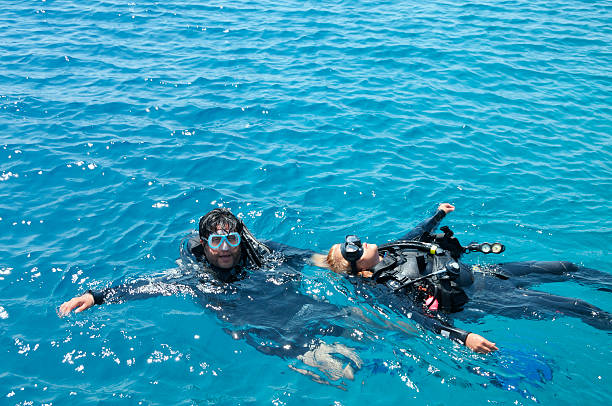
Have you ever observed a diver in distress on the surface? You may remember the classic signs - No air in the BC, mask on the forehead, mouthpiece missing from the mouth, the head just barely above the water, no buddy present, and not one sound uttered. What did you do?
Master divers should know, and Rescue scuba divers better know, that being prepared to conduct a rescue is as important as recognizing problems and the techniques used to resolve them. Preparation includes "Global Awareness", proper equipment, a predetermined and agreed upon emergency plan and a "Chain of Command." We are also aware that the most common problems requiring rescues occur on the surface and involve anxious divers who are having difficulty breathing and haven't established proper buoyancy.
Our reaction usually involves implementation of an emergency plan and getting to the distressed diver as quickly as possible without overexertion. Upon arrival, we know establishing buoyancy is our most important goal. We are also aware that by the time we arrive, the distressed diver is on the verge of or is experiencing panic. Did we attempt to attract the distressed diver's attention before making contact? Since this is standard operating procedure, have we bothered to learn why?
Unfortunately, some rescues of this nature seem
to be noisy, confusing affairs with lots of shouting and running
amok. It's amazing how an emergency situation can create
instant hearing loss in bystanders as well as
participants. Why else would someone be shouting at the
top of his/her lungs exhortations like, "You call for help!" or,
"you, put your equipment on and follow me!" and "Hey, you out
there, RELAX, DROP YOUR WEIGHT BELT AND INFLATE YOUR BC!" These
type of commands have their place, and can certainly be useful
in getting someone's attention. But consider this
question;
When the diver is in distress on the verge of panic, does the
rescuer really need the victim's attention in the first place?
The "quiet rescuer" considers the distressed diver's point of view. If we could interview a "rescued diver" immediately, we would learn several interesting things: 1) The diver didn't hear, much less understand, one single word. 2) He/she didn't signal for help early enough for fear of attracting attention and experiencing embarrassment. 3) The diver thought that the question "Are you O.K." absolutely ludicrous.
Let's go back to the point when a diver in
distress is identified, and consider the "quiet rescue"
technique. You may be in the water or on the boat or shore
when you recognize a problem situation. First and
foremost, remain calm and act quickly and with purpose.
Avoid shouting! As you approach the distressed diver, try
utilizing the following rescue sequence:
1. As you draw near the distressed diver, distract the
diver from the predicament by staying within his/her field of
vision and talking to him/her in a conversational tone.
What we say is of little importance, (the diver can't hear or
understand you anyway), as how we project a calm, friendly and
sympathetic tone.
2. Move in and touch the distressed diver
immediately! Human contact in stressful situation has an
immediate calming effect. Contact must be gentle but
firm. You can gauge the effectiveness of your rescue
efforts by "feeling" for a reduction in muscle tenseness.
If you remember to establish personal buoyancy during the
approach, you can share it with the anxious diver and meet the
goal of establishing the victim's buoyancy. Note:
This technique is for anxious, distressed or troubled
divers. Not for panicked divers - Panicked divers will
grasp at anything they can get there hands on and may grab the
rescuer - in this case remain negative and come up underneath
the victim and inflate their BC first, then yours. If the
victim grabs on to you and "fights" with you, you can always
descend. The victim will let go - the last place the
victim wants to go is down!
3. Now that you have the diver's attention,
it is time to say something meaningful and useful. At this
point there is a much better chance of comprehension. Talk
to the diver using reassuring phrases. ("You are fine",
"Relax, I've got you", "No problem, just relax." All while
ditching the weight belt or whatever the situation
warrants. The goal is to make this seem natural and
unobtrusive - like no big deal - you've done this before and you
know what you are doing - the distressed diver is in "good
hands".
4. As you talk to the diver, give simple instructions
designed to get his/her breathing under control - "Breathe slow
and deep". You may even want to demonstrate proper
breathing by exaggerating your own - "Breathe with me - In...
& Out....In....& Out........." The new goal is to
establish proper breathing and have the diver relax and "submit"
to your efforts. Patience is a virtue in this
instance. It takes time to calm a diver emerging from near
panic. If there is time available, use it. Begin a
leisurely swim back to the boat or shore.
5. Don't ask the diver to explain "what happened".
Sometimes the diver will try to justify to the rescuer "why" it
happened. Don't discuss this with the diver in the
water. You can say something like, "let's talk about it on
the boat".
A casual observer may never know that a rescue has occurred. With the quiet rescue technique, we may not look like "heroes" - but we will have acted in a professional, responsible manner that is the hallmark of a good scuba diver.
See ya down under...
Bwana

Aquastrophics Dive & Travel
(928) 680 - DIVE (3483)